I don’t really have any tips for doing this
other than having the name match the setting. Like if it’s a fantasy setting
like Lord of the Rings, the names
aren’t going to sound like your typical suburban residents’.
The same principle goes for naming places like
towns and cities and countries. If they aren’t set in our world, then they
likely won’t sound the same.
Here are a few name generators that I like to
use:
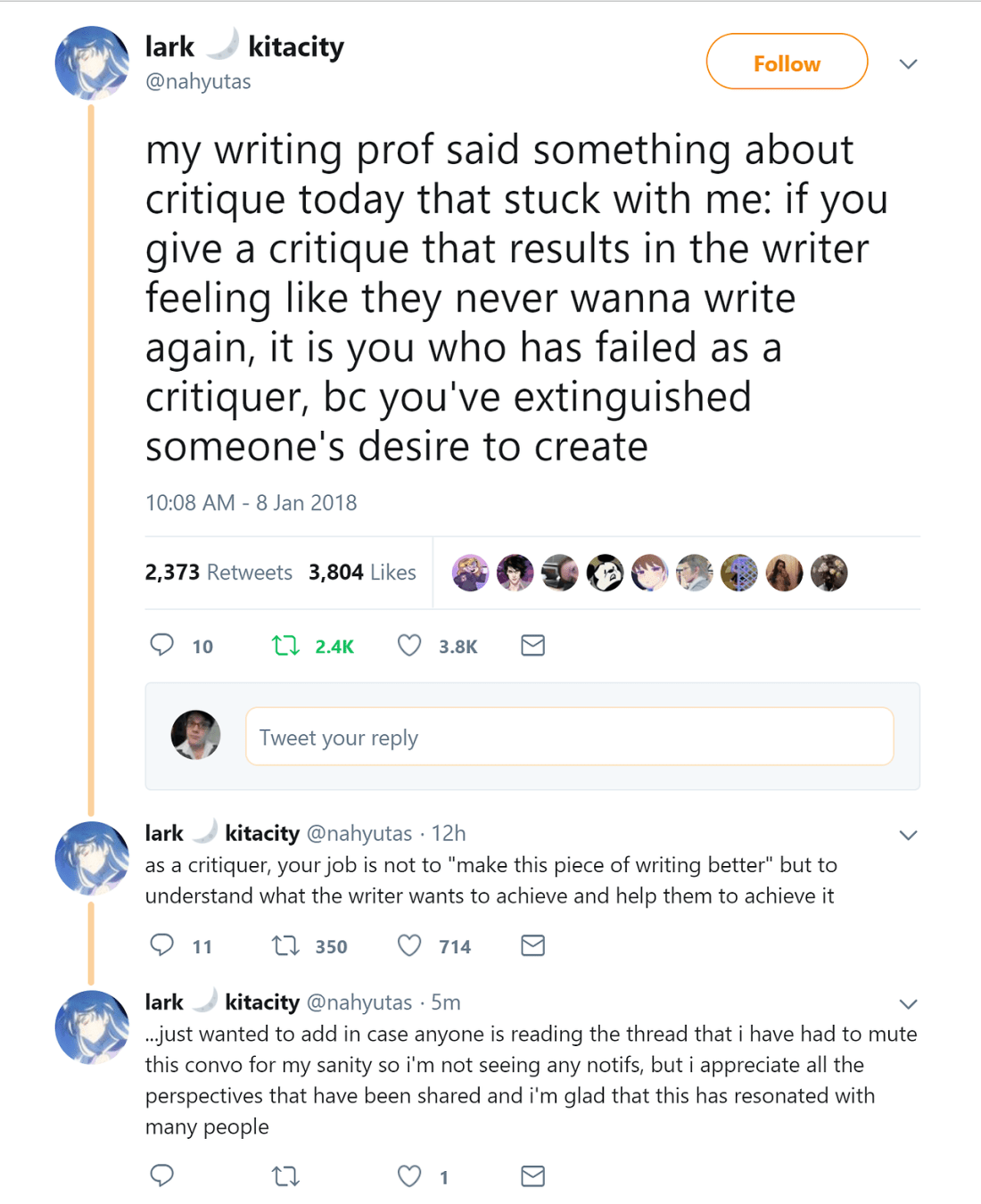
You have no idea how many people lurk on your work. No idea how many times people go back to revisit your work. How big they smile when they simply think about your work. How fast their heart beats, how excited they get when they see that you posted something.
People are shy with their feedback. Sometimes it’s because they’re simply shy. Other times it’s because they assume you already know how great and talented you are. Could be both.
My point is, even if you barely have any likes or reblogs, don’t get discouraged. You have a lot of silent fans, but they are still your fans. Keep on creating. Because there is always someone out there who will love what you have made.
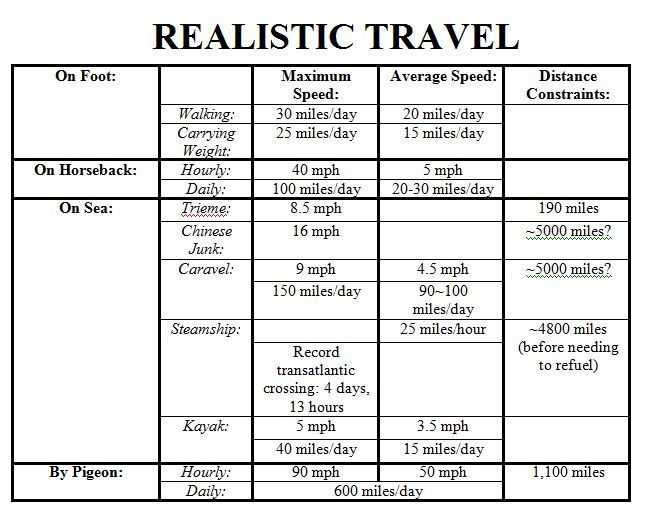
Although keep in mind that all these overland averages assume flat land. If you’re carrying a pack over a mountain range, you’re gonna go slower than if you’re carrying it across the plains. Then again, they also assume moderate rather than exemplary fitness levels–for instance, someone who’s spent the last four months through-hiking the Appalachian Trail with a 30-pound pack on their backs can do 40 mountainous miles on a hard-push day and average 18 to 20 miles on regular days, but they’re endurance athletes by then, and not your average merry-traveling-band stock (unless your merry traveling band has been traveling merrily over the mountains for a few months now :-p). Point is, while these numbers are incredibly useful for writers, you need to consider a number of factors that can affect them, and not just take the averages as gospel when you write.
I’m a researcher. Some might even say an information hoarder, and point to the network of private blogs and lists I maintain to keep track of every interesting post I stumble across like a dragon with a Tumblr account.
That’s why, over time, I’ve been building a little pile of resources for fanfic writers, despite not being one myself. I’m pushing the boundaries of what can be considered meta this week, but only in hopes of offering something useful to all you talented fic writers. ✌️
Fandom – Writing Resources
All About Writing Fight Scenes by @brynwrites, I (Bryn) will tell you a secret: I trained MMA for seven years, and when I write authentic hand to hand fight scenes, they sound dull too. The problem with fight scenes in books is that trying to describe each punch and kick and movement (especially if it’s the only thing you’re describing) creates a fight that feels like it’s in slow motion.
BDSM Info Week by @allspnships, et al, Few who write about BDSM and kink in fanfic have experienced the acts that they’re describing—and that’s absolutely fine. This is why research is a fanfic writer’s best friend when it comes to writing about anything they don’t really know firsthand. But researching BDSM and kink isn’t easy.
Britspeak to Amerispeak by @drgrlfriend, Writing a Teen Wolf fic where Derek takes this bloke Stiles to see a film in the cinema before taking him back to his flat to meet his mum? Writing a Sherlock fic where Sherlock meets John at college while studying for a big test so they both get good grades? If so, you need this Britspeak to Amerispeak directory.
Common Medical Mistakes by @ijustreallylovedaredevil, So I’ve noticed a bunch of medical errors in fics I read, so I decided to post this handy guide to some of the most common errors and some background on basic medical things.
Writing Deaf Language by @ao3commentoftheday, @feverything, et al, I need some input. At one point in a story of mine, two of my characters are going to communicate using sign language. I’m torn between trying to describe the motions, or writing it how it would be found in a sign language manual. I feel like the former would be harder to engage in, but the latter is usually written in caps, especially with finger spelling. I don’t want people reading it to think that they’re yelling at each other. Thoughts?
This is something that happens every day in your life. A shift of your eyebrow in skepticism, or the way your lip may twitch to a half smile cause you’re trying not to laugh. These behaviors are vital for writing in character, because not only do the allow you to visually see what is happening but it is also reaffirming whatever emotion your character is showing.
So why should you write it?
Much of human communication is non-verbal which means you need to also translate this non-verbal reaction in a post. It allows you to greatly enhance the emotions of another character and always another person to ‘visually’ see how they feel in a post. Most of all, this will add depth and volume to your post to make it feel more real. IT will make your character feel like a human instead of just another fictional person you look at from above.
Below you will find a list different type of emotions and what sort of body language can be exhibited to them.
Three ways to accent an action.
When writing about emotions, there are different ways to verbally write them out. Each one is unique in their own way, allowing you to show more about the emotion.
Emphasize the Emotion.
But doing this, you are expressing both the emotion and the body language. We’ll use a simple example. It’s short and simple yet you can sense he is happy.
John felt so happy that he was humming a tune while walking down the hall.
Complicate the Emotion.
Sometimes, even when you are feeling one emotion, deep down rooted underneath the facade of it all, there is actually an underlining emotion they feel. This is something you have to truly express otherwise no one will know.
John felt so happy that he was humming a tune while walking down the hall. However, it was obvious by the way his nose crinkled that he was disgusted by the actions beforehand. Instead, John covered it up by appearing pleased today.
Contradict the Emotion.
This is a little different than complicate. Contradicting means that you are claiming one thing when in fact its the other. In many ways, this has a variety of uses, from inner depth of the truth to what you see in person, or someone creating a wall. It could be considered a lie, but when is anything that easy?
John felt so happy that he was humming a tune while walking down the hall. In truth, once he was in the classroom, his shoulders slumped and a pout crossed his lips when no one was around, showing just how displeased he was with the situation.
Remember that you do not always have to contradict or complicate anything. Sometimes all you need to do is emphasize and that will be just fine. You don’t always have to have an underlining complicated for an emotion to make it more enhanced.
Do be afraid to use the Thesaurus to also improve an emotion. Such things as “happy” is a nice emotional word, but think of how much more powerful it is when you heard some is “overjoyed” or “content.” She how these emotions matched up with a body language can give two different styles of happiness? Mix and match to find what works best for your character at the time.
More In Depth Information
What I’ve stated above is more of a simplistic overview. IF you truly want to improve yourself, go to this
To see just how much body language can reveal about a person. You will find things such as how a person lies, how the eyes reaction, the positioning of a person in personal space, mouth, and head body language and so much more.
Use these resources to greatly increase the reactions of your character to another and create a more life-like world.
When you’re creating a race of people for your new world, you need a culture to give those people and their way of life some context. The culture helps determine how the characters act, dress, eat, solve problems, among so many other things. You can (and sometimes, should) have multiple cultures in your world, depending on how large your focus area is. Cultures affect each other, but also serve in a narrative sense to draw contrast in-world and to draw parallels to the reader’s world.
So here are some thoughts, big and small, that are meant to help inspire you as you create amazing cultures. (And remember that you’re thinking about the following questions in the context of the general population, not your main character(s).) You can simply answer these questions in short-answer form, or you can write a short story to flesh out one or two or three questions at once. If you do that, submit them to me! I’d love to feature them on the blog.
How old do people believe their race is? How old are they really?
How prevalent are religions to the common person?
What is/are the origin stories of the main religion(s)?
What do most people think should be the highest priority:
How do culturally shared priorities shape interactions?
What is the common greeting? Does it vary by age, class, rank, or sect?
How is gender viewed by the majority? Why?
What are common myths/legends of your people and how heavily do they influence the modern day?
How trustful are people of outsiders?
How welcoming are people, in general, of strangers into their homes?
How well do people of various factions (class, race, religion, etc.) get along in society?
How far has technology advanced, and how has it been implemented into their daily lives?
If magic exists, what do they believe is its origin? Its source?
If there is division between magic/non-magic, how do the two treat each other and why? How long has it been that way?
What sort of relationship do they have with their ruler?
How content is the average person?
How do people make their living and how big a part of their life is their career (if applicable)?
Do they have “weekends” and if so, what sets them apart from “weekdays”?
How do they treat their close friends?
How do they treat their enemies?
How do they handle small conflict, between individuals or small groups?
How do they handle larger conflicts?
How are they prepared for any potential war? Do they have some sort of military or militia in place?
How many wars have they, as a society, fought over the course of their lives/history? How much of an impact does that have on their cultural identity? (i.e. WW2′s impact on patriotism in America, and how it’s yet to go away.)
What virtues do they value in individuals? What virtues do they say they value? If those are different, why?
How do they dress? Does it vary greatly by gender, or not? Is their focus on clothing very practical, religious, sentimental, or simply driven by the latest arbitrary fashion? How do the above answers reflect on the culture on a deeper level?
How do they treat their elderly?
How do they treat their children?
At what age does a baby become a child, a child a young adult, a young adult an adult, an adult an elder?
How much regulation does the day-to-day life of the average citizen entail? Or, how involved is the government in micro affairs?
How are these people seen throughout their known world? How do other cultures view this culture?



 Karate, SPN Demonic Octopus Guardian